
Discover Barbaresco through elegant wines, beautiful landscapes and unforgettable encounters.
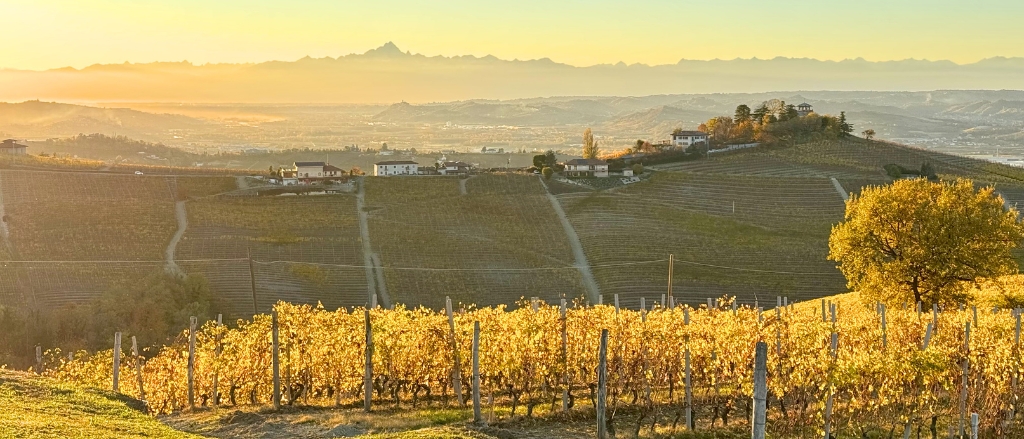
People often ask me whether I prefer Barolo or Barbaresco.
I always smile because I don't think it's a question that needs an answer.
To me, they are simply two different personalities.
If Barolo is often called the King of Wines, Barbaresco has always felt like its Queen.
They are both made entirely from Nebbiolo.
Their vineyards are only a few kilometers apart.
Yet they become remarkably different wines.
Part of the answer lies beneath your feet.
The soils are different. Many Barbaresco vineyards lie a little closer to the Tanaro River, creating a slightly different microclimate. Even the production rules are not exactly the same, with Barbaresco requiring a shorter minimum ageing before release than Barolo.
None of these elements alone defines the wine.
Together, however, they shape a style that many people first experience as more approachable in its youth, while still offering remarkable elegance and impressive ageing potential.
For me, that's one of the most beautiful things about the Langhe. The same grape can tell a completely different story simply because it comes from a different place.
One of the things that surprises my guests most is how compact Barbaresco actually is.
The denomination stretches across the villages of Barbaresco, Neive and Treiso, together with a small part of San Rocco Seno d'Elvio, within the municipality of Alba.
It's a relatively small wine area, yet the diversity you find here is remarkable.
Within just a few kilometers, you'll discover different vineyard sites, different soils, different exposures and different interpretations of Nebbiolo. One winery may be only a short drive from the next, yet the wines in your glass can tell a completely different story.
One of the things I appreciate most about Barbaresco is that we spend our day discovering wine — not driving between wineries. Everything is wonderfully close, which means we have more time for conversations, for tasting and simply enjoying where we are.
This is where Barbaresco becomes even more interesting.
Today the denomination is divided into 66 officially recognized MGAs (Menzioni Geografiche Aggiuntive), while neighboring Barolo has 181.
You'll often hear people refer to them as crus. It's a useful comparison, although here in Piedmont the concept is slightly different from Burgundy.
An MGA isn't a ranking of quality. Instead, it identifies a specific piece of land — its soils, altitude, exposure and microclimate.
Names like Asili, Rabajà, Ovello, Gallina or Montestefano aren't simply names on a label. They represent places.
Sometimes two vineyards are separated by only a few hundred meters. Yet the wines they produce can be surprisingly different. One may be more floral and perfumed. Another deeper and more structured.
Long before today's official MGA system was introduced, Barbaresco played an important role in recognizing the individuality of its vineyards. Visionaries such as Domizio Cavazza, followed by producers like Angelo Gaja and Produttori del Barbaresco, helped wine lovers look beyond the grape itself and begin understanding the places behind the wine.
I don't usually explain all of this as a lesson. Instead, I like sharing these stories while we're tasting. Because once you start looking at the hills around you, every glass begins to make a little more sense.
One of the questions I hear most often is:
"How do you decide which wineries we'll visit?"
The answer is actually quite simple. I don't start with the wineries. I start with you.
Some guests already know the producers they've always wanted to visit. Others simply tell me, "Olga, we'd love to discover the authentic side of Barbaresco."
That's the part of my work I enjoy most. Listening first. Then creating a day that feels personal.
When I curate an itinerary, I'm not only thinking about the wines. I'm thinking about the people you'll meet, the atmosphere you'll experience and the stories you'll take home with you.
Sometimes I'll recommend a historic estate because I know you'll appreciate its heritage. Sometimes it will be a boutique family winery where you'll have the chance to meet the people behind the bottles and hear their story first-hand.
And sometimes I'll suggest a winery simply because I know it offers one of those moments when everything comes together — the wine, the view and the feeling of being exactly where you should be.
Sometimes it's the wines that make a winery unforgettable. Sometimes it's the people. More often than not, it's both. That's what turns a wine tasting into something you'll remember long after you've returned home.
Every traveller enjoys a different rhythm.
Some guests like to visit several wineries and compare different expressions of Barbaresco. Others prefer taking their time. Perhaps we'll wander through the village of Barbaresco, climb the historic tower or visit the Enoteca Regionale del Barbaresco.
If time allows, I also love stopping in Neive, officially recognized as one of I Borghi più belli d'Italia — Italy's Most Beautiful Villages. It's one of those places that's best discovered without looking at the clock.
Maybe we'll stay longer over lunch because the conversation is too good to interrupt. Or perhaps we'll spend an extra half hour with a winemaker because everyone is enjoying the moment too much to leave.
If one day in Barbaresco leaves you wanting more, there are plenty of ways to continue your journey.
Many guests enjoy spending another day in neighboring Barolo, comparing two of Italy's greatest expressions of Nebbiolo and discovering how differently the same grape can speak from one denomination to another.
During truffle season, adding a truffle hunt is one of my favorite ways to experience another side of the Langhe.
Or perhaps you'd enjoy learning traditional Piedmontese recipes during a private cooking class, visiting a local producer of Nocciola Piemonte IGP, or simply lingering over a leisurely lunch surrounded by vineyards.
No two journeys are ever the same. And that's exactly how I believe they should be.
I don't believe there's one perfect way to experience Barbaresco. Some people fall in love with the wines. Others with the landscapes. Others with the people they meet along the way.
That's the beauty of this place. Everyone leaves with a different memory.
Let's create a private wine tour that feels like it was made just for you.
Let's chat now