
Villages, Nebbiolo & panoramic hills
Combine Barolo with La Morra, Monforte or Serralunga, choosing wineries that fit your taste rather than following a fixed route.
Discover the Private Barolo Wine TourExplore Piedmont your way
Discover the villages behind Piedmont’s most celebrated wines, compare the different personalities of the Langhe, and plan your trip with confidence using one interactive map.
Interactive Langhe map
Select a filter or click directly on a village. Each place reveals a different character of the Langhe — from Barolo landscapes to the elegant hills of Barbaresco and the food culture of Alba.
Barolo wine map · free download
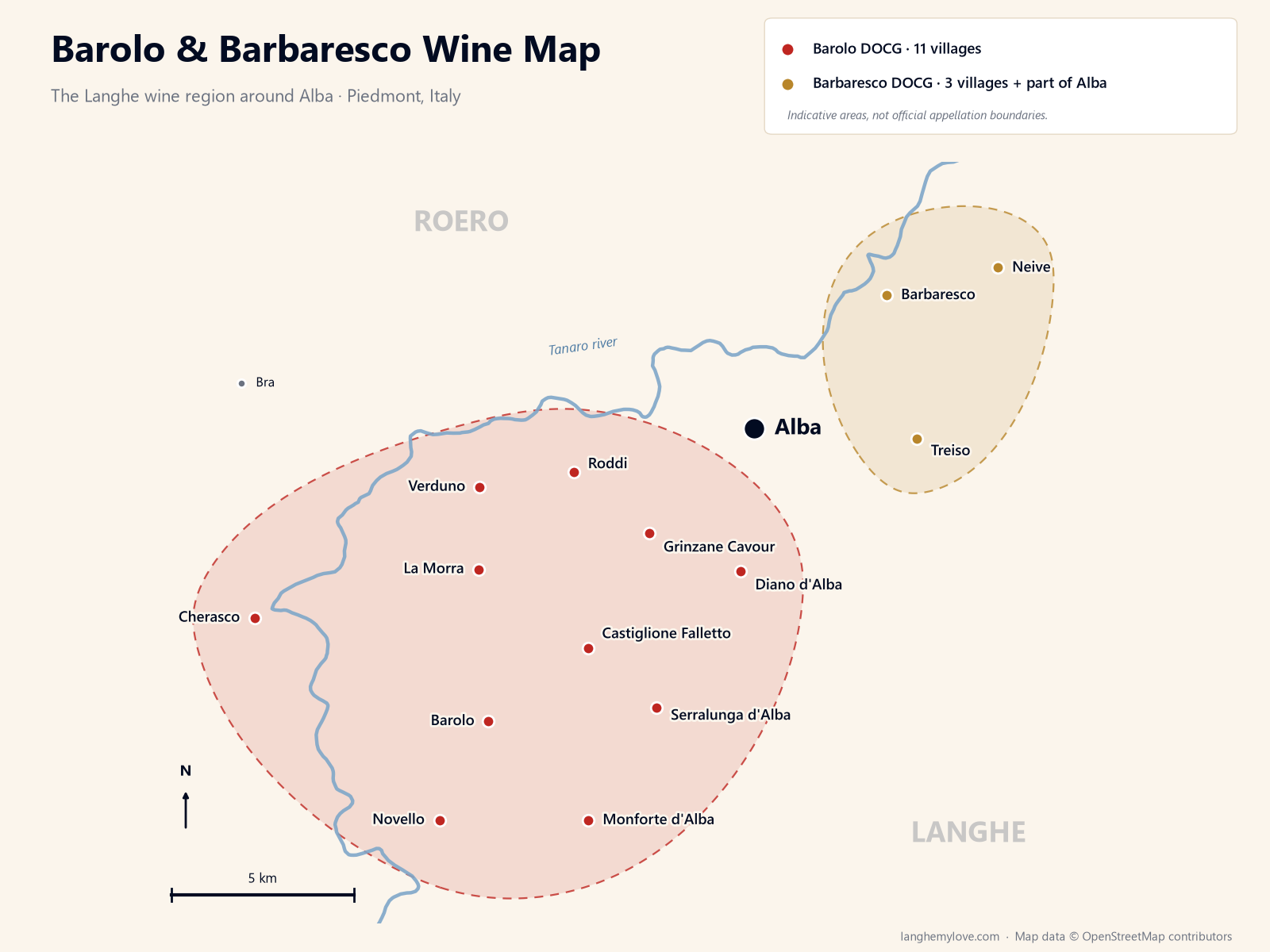
Prefer a classic map? This printable Barolo wine map shows all eleven Barolo DOCG villages, the Barbaresco area, Alba and the Tanaro river that separates the Langhe from the Roero. Save it on your phone before your trip – mobile signal in the vineyards can be patchy.
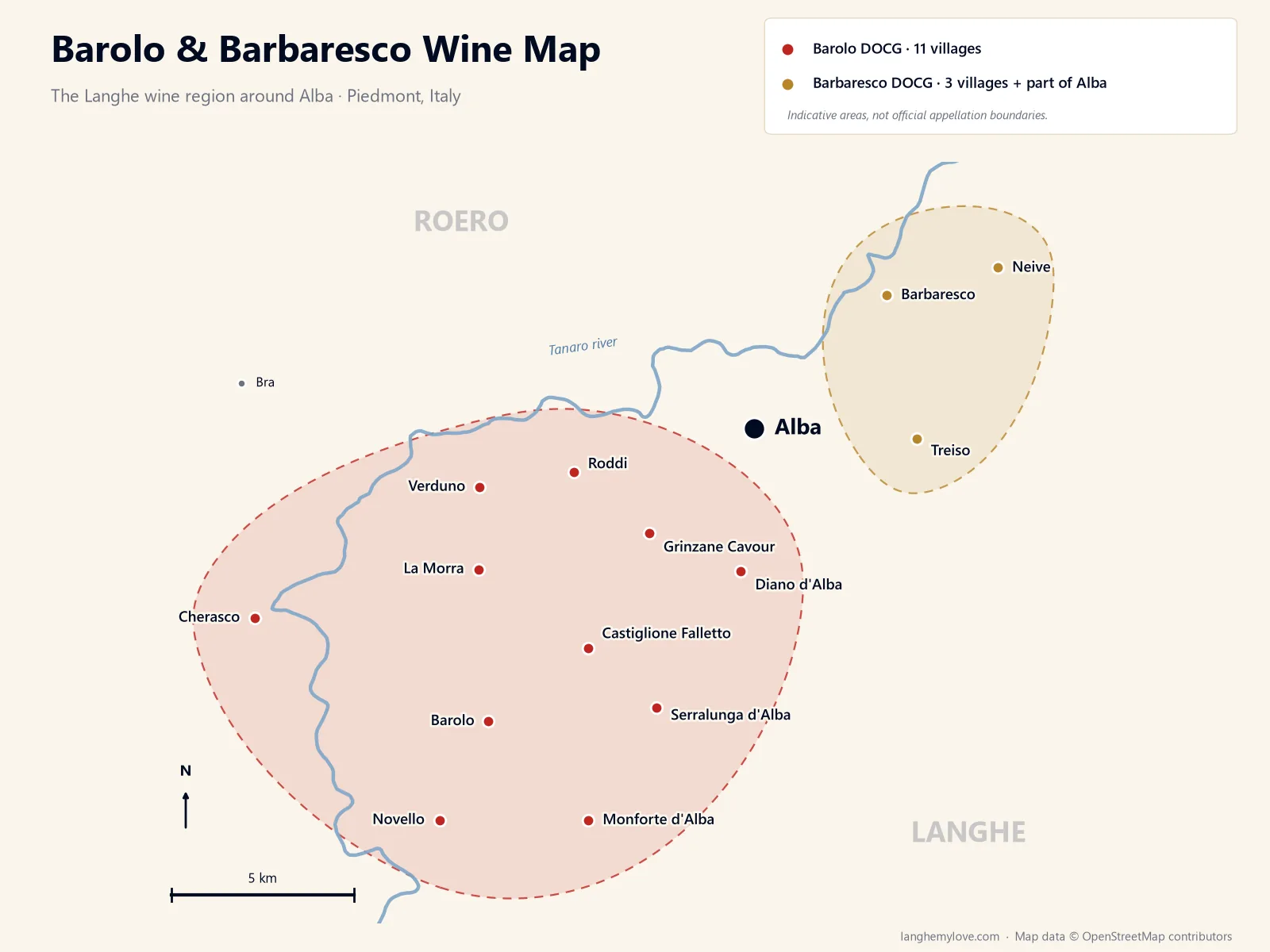
Use this map: you are free to share it or publish it on your website or blog, as long as you credit “© LangheMyLove” with a link to www.langhemylove.com/langhe-wine-map.html. Map data © OpenStreetMap contributors.
Three ways to explore
A map gives you the geography. A great day needs rhythm: the right wineries, enough time for conversation, a lunch worth remembering and room for the unexpected.
Combine Barolo with La Morra, Monforte or Serralunga, choosing wineries that fit your taste rather than following a fixed route.
Discover the Private Barolo Wine TourExplore Barbaresco and Neive, where elegant Nebbiolo, historic villages and unhurried tastings reveal a quieter side of the Langhe.
Discover the Private Barbaresco Wine TourStay in Alba and combine its historic centre, outstanding restaurants and the world-famous White Truffle with nearby wine villages.
Discover Private Truffle Hunting in AlbaBarolo & Barbaresco wine region map
The Barolo DOCG wine region covers eleven villages south-west of Alba: Barolo, La Morra, Castiglione Falletto, Serralunga d’Alba, Monforte d’Alba, Novello, Grinzane Cavour, Verduno, Diano d’Alba, Cherasco and Roddi. On the map you can see how close they are to one another and to Alba, which makes it easy to combine two wineries and a village in a single day.
The Barbaresco DOCG lies to the north-east of Alba, across the villages of Barbaresco, Neive and Treiso and part of San Rocco Seno d’Elvio. Use this Langhe map to compare the two wine regions and to see where Alba, the Roero hills and the castles of the Langhe fit into your itinerary.
Village by village
Driving times from Alba are approximate and assume normal traffic on hill roads. The vineyard names listed are a few of the best-known MGA crus of each village.
| Village | Appellation | Known for | From Alba by car |
|---|---|---|---|
| Barolo | Barolo DOCG | Castello Falletti and the WiMu wine museum; the Cannubi vineyard | ≈ 25 min · 15 km |
| La Morra | Barolo DOCG | The Belvedere viewpoint; Brunate, Cerequio, Rocche dell’Annunziata | ≈ 30 min · 15 km |
| Castiglione Falletto | Barolo DOCG | Hilltop castle; Monprivato, Rocche di Castiglione | ≈ 25 min · 13 km |
| Serralunga d'Alba | Barolo DOCG | 14th-century castle; Vigna Rionda, Francia – powerful, long-lived Barolo | ≈ 25 min · 16 km |
| Monforte d'Alba | Barolo DOCG | Lively historic centre and restaurants; Bussia, Ginestra | ≈ 35 min · 22 km |
| Novello | Barolo DOCG | Castle and the white Nascetta grape; Ravera | ≈ 30 min · 19 km |
| Grinzane Cavour | Barolo DOCG | Castle with the Enoteca Regionale Piemontese Cavour | ≈ 20 min · 10 km |
| Verduno | Barolo DOCG | The red Pelaverga grape; Monvigliero | ≈ 25 min · 14 km |
| Diano d'Alba | Barolo DOCG | Dolcetto di Diano d’Alba and its “sorì” vineyards | ≈ 15 min · 7 km |
| Cherasco | Barolo DOCG | Historic town, snails and Baci di Cherasco chocolates | ≈ 30 min · 21 km |
| Roddi | Barolo DOCG | Castle and the famous school for truffle dogs | ≈ 20 min · 9 km |
| Barbaresco | Barbaresco DOCG | Medieval tower and the Enoteca Regionale del Barbaresco; Asili, Rabajà | ≈ 25 min · 13 km |
| Neive | Barbaresco DOCG | One of “The most beautiful villages in Italy”; Gallina, Starderi | ≈ 20 min · 15 km |
| Treiso | Barbaresco DOCG | The Rocche dei Sette Fratelli; Pajorè | ≈ 20 min · 9 km |
| Alba (San Rocco Seno d’Elvio) | Barbaresco DOCG (part) | Gateway town; the International White Truffle Fair (October–December) |
Olga plans every private tour around your taste: two or three wineries, a village and a long lunch, without fixed routes.
How to read a Barolo map
MGA (Menzione Geografica Aggiuntiva) are the officially recognised vineyard sites of Barolo and Barbaresco – the Piedmont equivalent of a Burgundy “cru”. Barolo has 181 MGA and Barbaresco 66. When a label says “Barolo Cannubi” or “Barbaresco Asili”, the grapes come from that single named site. An MGA describes a place, not a quality ranking.
West and east of Barolo. As a broad rule, the western villages – La Morra, Barolo, Verduno – sit on younger, calcareous marls (Tortonian) and often give more perfumed, approachable wines. The eastern side – Serralunga d’Alba, Monforte d’Alba, Castiglione Falletto – has older, sandier and more compact soils (Serravallian) and is known for structured, long-lived Barolo. Every producer and vintage adds nuance, which is why tasting across the map is so rewarding.
Barbaresco, north-east of Alba, is lower and closer to the Tanaro river. Both wines are 100% Nebbiolo, but Barbaresco needs at least 26 months of ageing (9 in wood) against 38 months (18 in wood) for Barolo, and is often more approachable when young.
Langhe or Roero? The Tanaro river is the natural border: south and east lie the Langhe hills of Barolo and Barbaresco; north-west lies the Roero, with sandier soils, white Arneis and Roero Nebbiolo.
A wine traveller's guide
The Langhe are not one single wine destination but a collection of distinct wine regions, villages and landscapes that are best explored at a slower pace. Although Barolo, Barbaresco and Alba lie only a short drive apart, each offers a completely different perspective on Piedmont’s wine culture, gastronomy and countryside.
For many visitors, Barolo is the perfect introduction to Nebbiolo, with iconic villages such as La Morra, Monforte d’Alba, Serralunga d’Alba and Grinzane Cavour offering different landscapes, historic landmarks and winery experiences. Barbaresco, together with Neive, reveals a more intimate side of the Langhe, where elegant wines, compact distances and quiet village life encourage slower travel and longer tastings. Alba, famous for its White Truffle, outstanding restaurants and vibrant historic centre, makes an excellent base for discovering the entire region.
Because the villages are so close together, there is no single “best” itinerary. Some travellers focus on Barolo, others prefer Barbaresco, while many combine both wine regions with Alba, truffle hunting, cooking classes or day trips from Turin or Milan. The best experience depends on your interests, the season and how you enjoy travelling.
Part of this landscape forms the UNESCO World Heritage Vineyard Landscape of Piedmont: Langhe–Roero and Monferrato. This interactive wine map is designed to help you understand the geography of the region and plan a more rewarding journey. It is a practical travel guide rather than an official map of wine appellation boundaries.
Plan with confidence
Practical answers for travellers deciding how to divide their time between Alba, Barolo and Barbaresco.
Your map is only the beginning
Wine lover, first-time visitor, food traveller or simply curious: share your dates, interests and pace, and let's create a private experience around you.